
5 Cold Email Templates Based on 3.320.657 Emails Sent
- DealLead

- May 5, 2018
- 4 min read

Cold emailing works. I swear. And so do cold email templates. Actually, picking the right cold email template can make or break your outreach efforts! A cold email is easier set up than a cold call but it needs to be spot on.
Most of the templates you’ll see below are based on the exact emails our sales team uses to reach out to prospects and eventually convert them. The rest is emails we ourselves received that we found were pretty solid or stuff we grabbed from people we know to be authorities.
Shall we get to it?
A few general rules
Even though they’re all meant to be used in different circumstances, the cold email templates below do obey the 6 Commandments of cold-emailing.
Nail that subject line – That’s the difference between an opened and an unopened email. According to Convince and Convert, 35% of email recipients open emails based on the subject line alone.
Keep it short – They don’t know you, and they’re probably busy. Be smart, don’t waste their time with a foot-long page of information, you’ll have all the time to discuss that further down the road.
Make it personalized – Don’t just make it “personal” with merge tags, show you actually did some research. Mention their industry, competitors from the same niche, events they have attended, etc.
Bring social proof – If you can flash a few relevant names and data, knock yourself out. Bonus point if you’re already in touch with businesses or people they personally know.
Customize your from field – According -again- to Convince and Convert 43% of email recipients click the Spam button based on the email “from” name or email address. Would you rather open an email from Google or Larry at Google?
Avoid SPAM filters – According to a research by Cisco Systems, no less than 86% of the world’s email traffic is spam, which is why the war against spam is tougher than ever. Which is also why you’d do best not to use any spam trigger words, not attach files, or use URL shorteners!
The cold email templates
Here’s how to best use a cold email template:
Step 1: Assess the situation and pick the appropriate template
Step 2: Search for relevant information about your prospect
Step 3: Customize the template
Step 4: Plan 2 to 4 follow-ups
1. Classic approach – right contact

In what circumstances should you use it?
You don’t know who specifically to reach out to within the company
It’s a large enough company that the CEO might be bothered to take care of this
Why this cold email template is good:
The subject line summarizes the email perfectly
You address the prospect’s issue head on
You provide proof
You provide a clear call to action that makes it easy for the recipient to reply
If you’re starting out and/or you don’t have the means or the tools to identify who does what at the company you’re trying to close, this is a good starting point to start scaling campaigns.
These are the results of one of our oldest campaigns using this cold email template.

What? Cold emailing 1,792 people in a single campaign is savage, you say? We say it works!
2. Startup approach

In what circumstances should you use it?
You’re addressing a startup CEO/founder who you know has the authority on this kind of matters
Why this cold email template is good:
The subject line is offering help, not selling
You address the prospect’s issue head on
You provide proof
You provide a clear call to action that makes it easy for the recipient to reply
The main difference between this cold email template and the previous one is the informal tone, which makes sense when you address a startup owner.
3. Referral approach

In what circumstances should you use it?
You’re addressing someone you’ve been referred to by a mutual acquaintance
Why this cold email template is good:
You’re using the full power of your mutual acquaintance to have them open the email
By providing a short bit of history, you’re making it more relatable
You provide proof
You address their issue and mention their company (even though later in the message)
You provide a clear call to action, offering help that makes it easy for the recipient to reply
4. Event approach
Early on in our business, we used to spend time at trade shows promoting our software. A few days after one of these events, this gem hit us:

In what circumstances should you use it?
You’re taking advantage of an event where you know your prospect was to personalize your email
If a lot of professionals from the same niche were at the event, this is a great opportunity to contact a large group of people in personalized fashion
Why this cold email template is good:
Your knowledge of the presence at the event will make them curious about opening the email
By mentioning something specific, you’re making it more relatable and credible
You provide proof
You casually ask for a call
Even though we didn’t end up buying, it definitely got us on the phone!
You should, however, do your goddamn research. It’s not enough to know that your prospect was there. What were they doing there?
5. Busy recipient
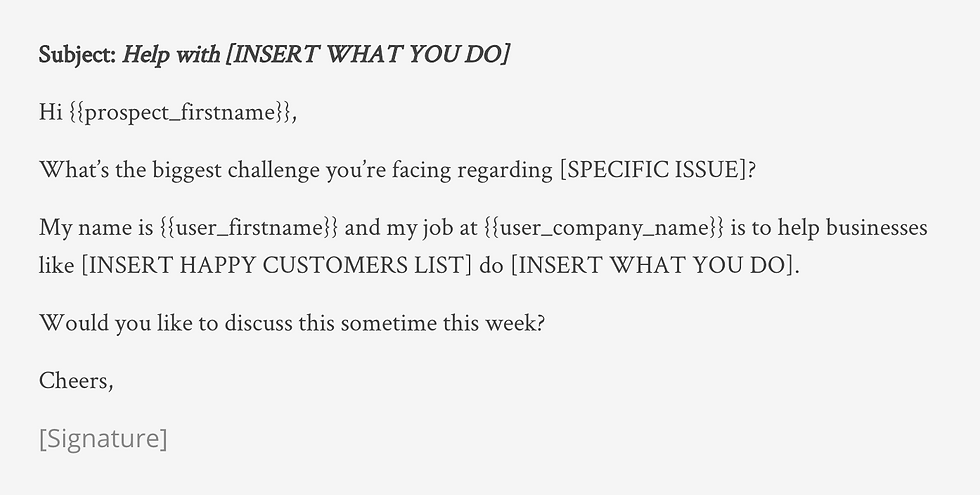
In what circumstances should you use it?
You know your prospect is someone very busy
You want to show that you acknowledge that
Why this cold email template is good:
You address their challenge immediately
You provide proof
You ask for a quick call
You actually keep it short
This kind of campaigns yields a nice open rate. This is how things turned out for us lately:

The campaign is still ongoing and more prospects will have been added to it by the time you read this but so far 10 new customers have signed on.
Written by Forster Perelsztejn

![Top 10 Lead Generation Tools in Digital Marketing [Infographic]](https://static.wixstatic.com/media/3df27b_23b923e8b3144dc78010c41020552e80~mv2.jpg/v1/fill/w_482,h_295,al_c,q_80,enc_avif,quality_auto/3df27b_23b923e8b3144dc78010c41020552e80~mv2.jpg)

Comments